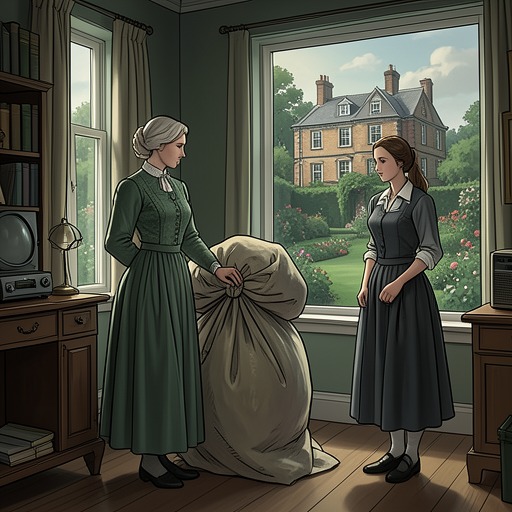
Selah Barnes
Mothering SundaySelah Barnes is Sunday Small’s employer at Yew Tree Farm, a seriously ill woman whose household authority is expressed through blunt commands, suspicion, and an insistence that Sunday’s worth be measured by her work. Her brief role makes the farm a place where Sunday must endure exploitation and unwanted attention while maintaining her own judgment and independence. Selah’s eventual death closes the arrangement, but it brings no easy grief or repaired relationship.
Identity and Arrival
Selah Barnes is first encountered seated beside the fire in the kitchen, heavily wrapped in blankets. She offers Sunday Small no welcome: she identifies her as the girl her husband has hired, then turns her attention to Mickey with an openly scornful question. Sunday bristles at the insult and identifies Mickey as her good friend, who has kindly brought her there. The exchange establishes a contrast between Selah’s contemptuous reception and Sunday’s readiness to defend someone she cares about.
Selah also tries to define Sunday on her own terms. After Mickey leaves, she asks why he called her Sunny and what her real name is. Sunday explains that her previous employer used the nickname, but gives her own name as Sunday. Selah dismisses it and says she will call her Girl instead. Sunday placidly accepts the form of address, but her calm does not erase the imbalance it marks: Selah controls the household, while Sunday has arrived needing work.
That imbalance continues when Sunday presents references from Biddy Spooner and Edgar Lockett, as her employer had instructed. Selah waves the papers aside, rejecting the value of written praise. She says she will judge Sunday by the amount and quality of work she does. The scene sets a practical, severe standard for the employment: Sunday’s previous service and character count for less, in Selah’s eyes, than labor performed to her satisfaction.
Authority in the Household
Within her first week, Sunday understands that she is treated as little more than a skivvy. She waits on Selah hand and foot, trying to make her comfortable, but receives neither thanks nor kindness from Selah’s son Bill Barnes or her husband. The lack of recognition is not incidental to Sunday’s experience of the job; it is part of the household’s arrangement, in which her service is expected and her standing remains low.
Selah’s own frailty complicates, but does not undo, her harshness. Sunday sees blood-stained rags left in the soak bucket each night and recognizes that Selah is dying of consumption. When Selah coughs, Sunday feels sorry for her despite finding her difficult to live with. She continues to care for her, even without thanks. The text thus places Selah’s vulnerability beside her authority: she is gravely ill and dependent on Sunday’s care, yet Sunday remains the subordinate who must provide it.
Selah’s view of Sunday’s future is equally governed by household need. When Sunday comes back downstairs after making sure Bill has gone out, Selah weakly suggests that she might play her cards right and marry him. Selah imagines that, after her death, Bill and his father will need a woman to keep house for them. Sunday answers politely that she does not intend to marry for a long time. She privately rejects Bill as a brute, but does not say so aloud. The proposal treats marriage less as a mutual choice than as a way to secure domestic labor for the men after Selah is gone.
Conflict and Departure
Bill’s behavior makes Selah’s proposal particularly unwelcome. Sunday has nearly packed her things and walked out during the month at the farm because Bill becomes over-familiar whenever he can. The day before Selah makes her suggestion, Bill pinches Sunday’s bottom as she carries pots to the sink. Sunday sets the pots down on the large wooden draining board, returns to him, and slaps his face. Bill laughs rather than being deterred, telling her he likes a girl with spirit. Sunday leaves for her room in a sulk, more convinced than before that she detests him. Her resistance is direct, but it does not make the farm safe or bring the unwanted conduct to an end.
The possibility of leaving becomes an open confrontation when Selah finds Sunday hurrying downstairs. Sunday says she had already told Selah the night before that she was leaving. Selah responds by accusing her of stealing her pearls and insisting she cannot go until she returns them; otherwise, Selah threatens to call the police. Sunday is astonished and denies having the pearls. Selah orders Bill to search her bags. The scene turns Sunday’s departure into a struggle over control: Selah invokes the police and the missing jewelry to hold an employee who has said she intends to leave. The evidence does not establish what becomes of the accusation at that moment.
Death and Narrative Significance
After Sunday has left the Barnes household, Edgar Lockett gives her an envelope containing her wages from the family, apologizing for the delay. He then tells her that Selah died the previous night. According to the doctor, her heart failed. Sunday is sorry to hear the news, but cannot pretend to be grief-stricken: Selah had never given her a kind word despite all the care Sunday provided. Sunday also considers that death may have released Selah from her lung disease.
Selah’s ending leaves the relationship unresolved. Her dependence on Sunday’s care never becomes gratitude, and her final remembered exercise of authority is the accusation that Sunday has stolen the pearls. At the same time, Sunday’s response to Selah’s illness is neither simple devotion nor indifference: she attends to her, pities her suffering, and acknowledges the possible mercy of her death, while refusing to manufacture affection that their relationship did not contain. Through that contrast, Selah’s role clarifies the cost of Sunday’s employment at the farm and the limits of the household’s claim upon her.